Student Log in
 1267 Cornwall Rd, Unit 300, Oakville, Ontario L6J 7T5


 (289) 271-5718
blog
An Anatomy Refresher for Injectors: Facial Anatomy Every New Injector Should Revisit
Nov 20 2026
Reading Time: 5 Minutes
Facial anatomy is the base of safe, thoughtful injectable practice. Products and techniques may change, but the structures under the skin do not. For a new injector, returning to facial anatomy after basic training is not a sign of weakness. It is a professional habit that supports better assessment, clearer communication, and more careful choices.
This article is for training only. It is a training refresher that uses plain language and does not give medical advice for patients. It does not replace program-specific training, supervised practice, or guidance from a regulator or professional college. Learners should check scope, supervision, and local rules before they apply any concept in practice.
Why anatomy comes before technique
A patient sees the surface. An injector must see the layers beneath it. A product placed without an understanding of anatomy can reach a vessel, a nerve, or a muscle it was never meant to reach. That risk is why anatomy is taught before technique, and why it should be revisited after basic training.
Anatomy also shapes the plan. A learner who knows the muscles of the face can predict how an expression will change. A learner who knows where the vessels run can choose a safer entry point. A learner who knows the fat compartments can judge where volume is lost. Without that knowledge, an injection becomes a guess.
A refresher does not need to be a full course. It can be a short, focused review of the structures a learner actually treats. A learner should revisit the areas they inject most, the areas they avoid, and the areas where they feel least sure. That focus makes the review useful instead of overwhelming.
The face in layers: skin, fat, muscle, bone
A useful way to think about the face is in layers. The skin is the surface. Beneath it sit the fat compartments, then the muscles, then the bone. Each layer moves and ages in its own way. A product placed in one layer behaves differently from the same product placed in another.
Fat is not one sheet. It sits in compartments that change with age. A compartment can lose volume, and the skin above it can sag. A learner who understands compartments can judge where volume is missing and where it should not be added. That judgement matters more than the product chosen.
When a learner thinks in layers, the discussion becomes clearer. A treatment can be described by layer, by depth, and by structure. A learner can explain why a product is placed at a certain depth, and why a different depth would be wrong. That clarity helps with planning and with patient communication.
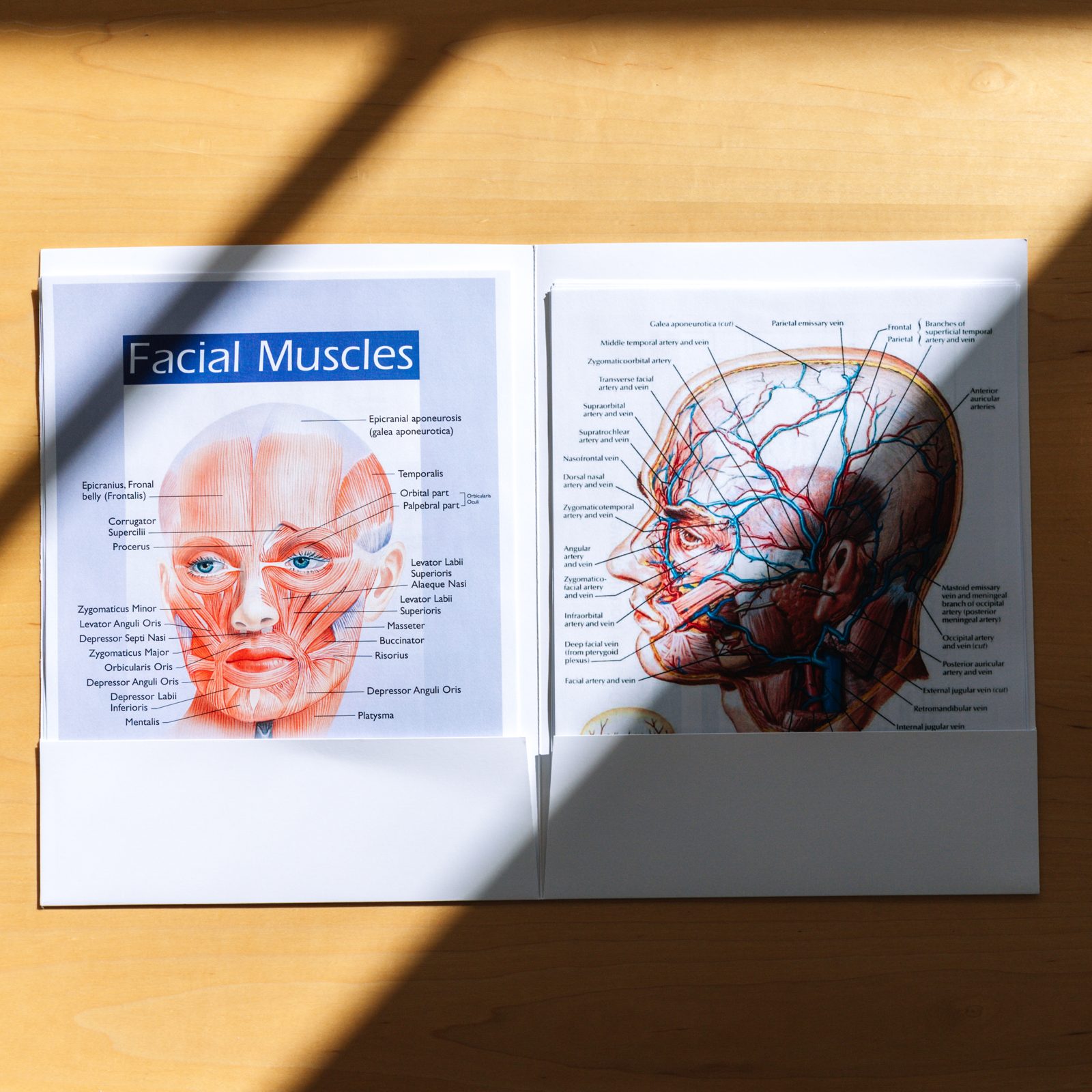
Those relationships turn a diagram into practical understanding. A diagram shows where structures sit. A refresher should connect the diagram to a treatment decision. A learner should ask, for each area, what lies beneath the surface, what could be injured, and what a safer choice would be.
Muscles of the face and expression
The muscles of the face control expression. A learner should know the main muscles, where they attach, and what they do. A muscle that lifts the brow, a muscle that closes the eye, and a muscle that pulls the mouth down each play a part in how a face moves. A product placed near a muscle can change that movement.
A learner should also know how muscles work in pairs. A muscle that lifts is balanced by a muscle that pulls down. When one side is treated and the other is not, the balance can shift. That shift is why a treatment should be planned across the whole face, not one spot at a time.
A simple habit helps. Before a treatment, a learner can name the muscles in the area, ask what they do, and note what would happen if they were weakened. That short check turns anatomy from a memory task into a planning tool.
Vessels and nerves: why caution matters
Vessels and nerves deserve special attention. A vessel can carry a product to a place it should never reach. A nerve can be injured by a product placed too close. A learner should know the main vessels and nerves in each area they treat, and should treat those areas with care.
Vascular occlusion poses a serious risk. It occurs when a product blocks a blood vessel and the tissue it supplies does not receive blood. A learner must know the signs of vascular compromise and be able to act immediately. Any delay can lead to tissue injury.
This article does not give a treatment protocol. You must check program-specific emergency planning, supervision, and local guidance separately.
Nerves matter for assessment too. A learner should know which nerves serve each area, and should ask about numbness, tingling, or weakness after a treatment. A change in sensation is a sign to pause and seek advice, not a detail to note and move past.
High-attention areas to study, not rush
Some areas deserve more study than others. The nose, the glabella, and the temples are often named as areas where vessels run close to the surface. A learner should study those areas in detail before treating them, and should not rush into them after basic training.
The lips also deserve care. The vessels that supply the lips are close to the surface, and the tissue is mobile. A learner should study the lip anatomy, the vessel paths, and the signs of a problem before treating the lips. A careful plan matters more than speed.
A learner should also study the areas they treat least. An area that is treated rarely is an area where knowledge fades first. A refresher that covers the least-used areas is a refresher that protects the learner where they are weakest.
How to build a useful anatomy refresher habit
A refresher habit can be simple. A learner can set aside a short time each week to review one area, one muscle group, or one vessel path. A learner can sketch the area from memory, then check the sketch against a chart. That short exercise shows what is known and what needs review.
A learner can also link the review to real cases. After a treatment, a learner can ask what structures were involved, what was avoided, and what would have happened if the plan had changed. That reflection turns each case into a refresher.
A learner should also ask for help when unsure. A supervisor, a colleague, or a program can help with a question about anatomy. Asking is not a weakness. It is a professional habit that protects the patient and the learner.
Questions and answers
Why should injectors revisit facial anatomy after basic training?
Facial anatomy is the base of safe practice. A refresher helps a learner assess better, plan more clearly, and recognise risk. A learner who revisits anatomy is building a habit that supports safer practice.
What is the simplest way to study facial anatomy?
A learner can review one area at a time, sketch it from memory, and check the sketch against a chart. A learner can also link the review to real cases by asking what structures were involved and what was avoided.
Does knowing anatomy remove risk?
No. Anatomy knowledge reduces risk, but it does not remove it. A learner should combine anatomy knowledge with careful technique, good assessment, and a clear plan for when to seek help.
A refresher is not a one-time task. A habit that supports safer, more thoughtful practice. Learners who revisit facial anatomy, the muscles of the face, and nearby vessels and nerves will assess better. They will communicate more clearly and know when to pause and ask for help. That caution is a strength, not a limitation.
Tips to be a
Successful Injector!
Free E-Book download